



 0

 1

NGENLA (Somatrogon) for sale

What does Ngenla mean and when can it be useful?
Ngenla is composed of the active substance, somatrogon which is a biosimilar of the recombinant human growth hormone. The Human Growth Hormone that comes naturally in the body is needed for the growth of bones and muscles. Besides, it helps to achieve enough caliber of adipose tissue and muscle compartments. Ngenla belongs to the class of recombinant growth hormones. It means that it is derived from cells which have been altered using genetic engineering technology.
Ngenla is indicated for the management of growth failure in pediatric patients with growth hormone deficiency confirmed using growth hormone Nazis in children below 6 years of age and by auxological and biochemical criteria in older children.
Therapy of growth disorders can only be started and continued only after consulting a special doctor.
You must follow the doctor's prescription.
Usage of the Ngenla
It is important to follow all your doctors’ instructions strictly when using this drug. If in any respect unsure, please consult your doctor, pharmacist or any other relevant healthcare professional. Use of Ngenla should be performed under the supervision of a doctor who is experienced with GHD on a continuous basis in most cases. This tells us that it is your doctor who determines the amount of Ngenla to inject. The dose should not be altered without first seeking professional advice from the doctor.
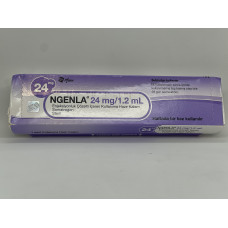
The recommended dose is 0.a Betamethasone Valerate Excipients: Microcrystalline cellulose, Raising agent: sodium bicarbonate, Colour: indigo carmine and the pseudephedrine hydrochloride is a local decongestant. The above supplements are available in tablets; the dosage is 66 mg/kg body weight once a week. Your doctor will give you or your child the right pre-filled pen to preset and give the set dose as recommended. It is available as a single-joint prefilled pen in two doses namely, Ngenla 24 mg and Ngenla 60 mg.
Ngenla is supplied as a solution for subcutaneous injection in a pre-filled pen for first-time users, which is used in subcutaneous injection. It is not for intramuscular or intravenous administration or use.
The preferred sites for injection with Ngenla are subcutaneous abdomen, thigh, buttock or arm. Injections into the upper arm or buttock should be administered by the caregiver.
Rotate the injection site once a week, that is if one is to administer the weekly dose.
Where several injections are required to complete the dose dispensed, sites ought to be distinct and several from the previously used locations.
Learn how to use the pen before using it for the first time; your doctor or health care professional will guide you on how to use it.
Further information about the pen and its application will be provided to you as a patient at the end of the patient information. As much as using Ngenla, one has to ensure that they read the pre-filled pen instructions.
It must not be changed within the dosage that has been prescribed by the doctor. Speaking of the last side effect, you should know that if the effects of the medication are mild or too strong, you have to contact your doctor or pharmacists without any delay.
When do you need to take Ngenla?
Take your medicine once per week, anytime.
To ensure that you do not forget to inject once a week, you should write down the day of the week that you use Ngenla.
When needed, you can change the day of the week you inject the medication, as long as at least 3 days have passed since your last injection. Once you have chosen the new day of the week, you will continue to take the medicine once a week on the new day set.
What happens if you use more Ngenla than you were prescribed?
If you use up more Ngenla than prescribed, tell your doctor immediately as you may need to monitor your blood glucose levels.
If you miss a dose of Ngenla
If you miss one dose:
- it has been more than 3 days since your last scheduled injection of Ngenla, administer Ngenla as soon as you remember. Then give the next dose of Ngenla as normal on the day of the week when it is scheduled.
- If it is more than 3 days since the last scheduled injection of Ngenla, do not take the missed dose. Inject the next dose as usual on the scheduled day of the week. The injection should always be given on the same day of the week.
Do not double dose!
If you discontinue use of Ngenla
Do not stop taking this medication without talking to your doctor first.
Ask your doctor, pharmacist or health care professional if you have any further questions about the use of this medicine.
Use in children under 3 years of age
For children under 3 years of age, the benefits and safety of Ngenla have not been established.
What possible side effects may you experience with Ngenla?
Very frequent (affecting over 1 in 10 people)
Reactions at the injection site (e.g. pain at the injection site, redness, itching, swelling, inflammation, hardening, bruising, heat), hypersensitivity reactions (e.g. fever, allergic inflammation of the conjunctiva, increased number of a certain type of white blood cells [eosinophilia]), headache, increased serum phosphate (detected by blood test).
Frequent (affects 1-10/ 100)
Low red blood cell count (anaemia), hypothyroidism, joint pain, pain in the arms or legs.
Occasionally (affects 1 to 10 people in 1 000)
Adrenal insufficiency (adrenal insufficiency, symptoms may include weakness, fatigue, browning of skin, loss of appetite, weight loss, nausea, vomiting, diarrhea), rash.
Please tell your doctor or pharmacist if you notice any side effects. This applies especially to side effects that are not mentioned in this leaflet.
Where can you find Ngenla? What packages are currently available on the market?
It is available only in pharmacies with a non-renewable medical prescription.
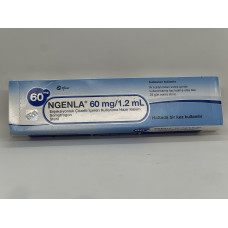
Ngenla 60 mg/1.2 ml: pack containing 1 prefilled pen at 60 mg/1.2 ml [A].
Marketing authorisation holder - Pfizer AG, Zurich.
For subcutaneous injection only.
Before using your Ngenla pre-filled pen, please read the package insert (patient information) and these instructions ENTIRELY.
Keep the package in its original packaging. These instructions will give you step-by-step instructions on how to prepare and administer the injection.
Important information about Ngenla pens
- The Ngenla solution for injection is a pre-filled, multi-dose pen. The pen can be used to inject several doses.
- Ngenla solution for injection can be administered by the patient or by a nurse, doctor or healthcare professional. Do not attempt to inject Ngenla yourself unless you have been shown how to inject it correctly and have read and clearly understood the instructions for use. If your doctor decides that you or a carer can inject Ngenla at home, you must be trained in the correct way to prepare and inject Ngenla. It is important that you read, understand and follow these instructions to ensure that Ngenla is injected correctly.
- To understand the Ngenla dosing instructions that apply to you or your child, it is important that you talk to your doctor, healthcare professional or pharmacist. To help you remember when you need to inject Ngenla, you can use a calendar to mark the days in advance. Ask your doctor, nurse or pharmacist if you or your nurse has any questions about how to inject Ngenla correctly.
- Do not share your pen with others, even if the needle has been changed, as you risk passing on a serious infection to others or a serious infection to yourself.
- Each turn (click) of the dosage button will draw 0.5 mg of medication. The pen can deliver 0.5 mg to 30 mg of medicine in a single injection. If you or your child needs more than 30 mg, you should give more than one injection.
- After all doses have been given correctly, there may be a small amount of medicine left in the pen. Do not try to use this medicine. After the last dose is administered, the pen should be disposed of according to the instructions.
- For each injection, use a new sterile needle. This reduces the risk of contamination, infection, spillage and needle blockage causing an incorrect dose.
- Avoid shaking the pencil. It may damage the medicine.
- The pen is not recommended for use by blind or partially sighted people without the assistance of a person trained in the correct use of the product.
Equipment required for each injection
Included in the package
– 1 Ngenla pre-filled pen
Not included in the package
– 1 new sterile needle for each injection
– Alcohol pads
– Cotton balls or gauze pads
- Adhesive plaster
– Container reserved for the disposal of needles and pens

Usable needles
Pen needles are not supplied with the Ngenla pen. You can use pen needles ranging from 4mm to 8mm.
- For use with the Ngenla pen the following needles are suitable:
- 31G or 32G
- Talk to your doctor or pharmacist to find out which needle is best for you or your child.
Modeled sterile needle, not supplied

Be careful: Do not use bent or damaged needles. Always handle pen needles carefully. Make sure you do not stick yourself (or anyone else) with the needle. Until you are ready to inject, do not attach a new needle to the pen.
Prepare to inject

- Wash your hands and then dry them with tissue.
- You can use your pen as soon as you take it out of the fridge. For a more comfortable injection, you can allow your pen to stand at room temperature until 30 minutes have elapsed.
- Check your medicine name, dose and label.
- Check the pen label to see when it expires. If the pen is past its expiry date, it should no longer be used.
- In the following cases the pen must not be used:
- When the pen is frozen or exposed to heat (above 30°C).
- If it has fallen to the ground.
- If it looks faulty or broken.
- If the pen has been used for more than 28 days.
- After more than 4 hours out of the fridge.
- If you have used the button five times before.
- Do not remove the protective cap from the pen unless you are ready to inject.

- Ngenla can be injected into the abdomen, upper thighs, bottom or arm.
- Follow the advice of your doctor, pharmacist or nurse to choose the most appropriate injection site.
- If you need to inject yourself more than once to get the full dose, you should use a different site for each injection.
- Never inject into a bony, haemorrhagic, red, painful or tender area, or into a scarred or diseased area.
- Use an alcohol swab to disinfect the injection site.
- Allow the site to dry before injecting.
- After disinfecting the site, do not touch it.

- Take the cap off the pen and keep it - it will come in handy after you have injected the medicine.
- Check the medication in the cassette holder.
- Check that it is clear. It should be colorless to slightly yellow. If it is cloudy or dark yellow, do not inject.
- Make sure there are no suspended particles in the medicine. Do not inject the medicine if there are any suspended particles or particulates.
Caution: It is normal for the medicine to have one or more air bubbles.

- Remove the protective film and insert a new needle.
- Point the needle horizontally towards the pen. Hold the pen horizontally as well.
- Gently squeeze the needle and screw it onto the pen. Take care not to force the needle.
Note: Make sure that the needle does not form a slanted angle with the pencil. Doing so may result in leakage from the pen. Caution: Both ends of the needle are sharp. To avoid pricking yourself (or someone else), handle the needle carefully.

- Take off the outer cap.
- Keep the outer cap. It will be used later to remove it.
Note: You should be able to see the needle's inner shield after removing the outer shield. If it is not visible, try reinserting the needle.

- Carefully remove the needle shield from the inner side so that it can be seen.
- Discard the inner needle shield in a container intended for disposal of syringes and needles. It is no longer needed.

Preparation of a new pen (called "priming") - only the first time a new pen is to be used.
Each new pen needs to be prepared (primed) before it is used for the first time.
- Before a new pen is used for the first time, it must be "primed".
- To eliminate air bubbles and ensure the correct dose is injected, a new pen must be primed.
Important: If your pen has already been primed, proceed from step A to step C.

- Turn the dose setting button to position the button to 1.0.
Note: You can turn the adjustment knob in the opposite direction if you have moved it too far.

- Hold the pen with the needle pointing upwards to allow any air bubbles that may be present to rise to the surface.
- To remove any air bubbles, gently tap the cartridge holder.
Important: Even if no air bubbles are visible, follow step B.

- Press the injection button all the way down until a "0" shows on the dose display.
- Check for fluid coming out of the needle tip. If yes, the pencil is ready.
- Always check that a drop of fluid appears before injecting. If no drop appears, repeat steps A to C.
- If no drop appears after repeating steps A to C five times, insert a new needle and retry.
- If no drop appears after replacing the needle, stop using the pen. Use a new pen and contact your doctor, nurse or pharmacist.
Adjusting the prescribed dose

- Set your dose by turning the dose adjustment knob.
- Turning the knob in either direction will increase or decrease the dose.
- You can increase or decrease the dose in 0.5 mg increments using the dose adjustment knob.
- There is 60 mg of medicine in the pen, but the maximum dose that can be set for an injection is 30 mg.
- The dose display shows the dose in mg. Refer to examples A and B
You should always consult the dose indicator to make sure that the pen has been set to the correct dose.
Important: When adjusting the dose, be careful not to press the injection button.
What can I do if it does not deliver what I need?
- You will need to give more than one injection if your dose is more than 30 mg.
- In a single injection, the pen can deliver between 0.5 mg and 30 mg of medicine.
- Ask your doctor, pharmacist or other healthcare professional if you need help distributing your dose correctly.
- Use a new needle every time you inject.
- Do not forget your second dose if you usually need 2 injections to get your full dose. Follow the same procedure for the second injection as for the first.
If there is not enough medicine in the pen, what should I do?
- If there is less than 30 mg of medicine left in the pen, you will no longer be able to turn the dose adjustment knob and the dose indicator will show the amount of medicine remaining.
- If there is not enough medicine left in the pen to give you a full dose, you have two options:
- Firstly, inject what is left of your medication and then prepare a new pen to inject what is left.
Remember to subtract the dose already given. For example, you will need to use a new pen to inject the remaining 4.5 mg if your dose is 21.5 mg and the dosage knob can only be set to 17 mg.
- Alternatively, you can use a new pen to administer a complete dose. Discard the old pen.
Dosing the injection

- Hold the pen in such a way that you can read the numbers on the dose display.
- Insert the needle into your skin in a vertical position.

- Hold the hypodermic needle in the same position on the skin as before.
- Fully depress the injection button until a "0" is visible on the dose display.

- Count to 10 while still holding down the injection button. Counting to 10 makes sure you have given the full dose.
- Release the injection button and slowly withdraw the pen from the injection site by pulling the needle vertically outwards after counting to 10.
NOTE: Some medicine may remain at the tip of the needle. This is normal and has nothing to do with your current dosage.

- Gently replace the outer cap onto the needle.
- Push down on the outer cap until it is firmly in place.
Warning: Do not attempt to replace the inner cap on the needle. The needle could accidentally puncture you.

- Screw the needle out of the pen with the needle guard on.
- Pull lightly on the needle shield until the needle comes off the pen with the shield attached.
NOTE: If the needle is stuck, replace the outer needle cap and try again. When unscrewing the needle, be sure to apply pressure.
- Dispose your used hypodermic needles in a sharps container. Keep the sharps container out of the reach of children.
Important: Always remove used needles from the pen and discard. Do not reuse needles.

- Put the cap back on your pen or pencil.
- If there is a needle attached to the pen, do not replace the cap.
- If there is any medicine left in your pen, store it in the refrigerator between uses (see "What else should you know?").

- Use a cotton ball or clean gauze pad to slightly compress the injection site for a few seconds.
- The injection site may have some bleeding. You may experience some bleeding. This is a normal reaction.
- If necessary, you may want to cover the injected area with a small adhesive bandage.
- Throw away empty pens or pens that were first used more than 28 days ago, even if they still contain medicine. You should dispose of your pen in the container that is intended for the disposal of syringes and needles.
- To help you remember when to dispose of your pen, write the date of first use on the pen label and below:
Date used for the first time ______. ______. ______
- If you need another injection, follow the instructions again from step 2.
END OF THE MANUAL.